Archive for the 'Running in the South' Category

Rite of Spring 31Jan08

Spring has Sprung
January Flower seen today in my yard. “Bae yeak gul bahear namesaewaed”

Now that winter has abated in South Carolina, we can look forward to the impending vernal equinox. It’s time for milder weather (it was a frosty 65 yesterday), Stravinsky tunes, cleaning out the closets, and of course the Boston Marathon.

sigh.

Kind readers, I am determined to line up at Hopkinton this summer (April 21st qualifies as summer here). To this end, I’ll soon run the dreaded Myrtle Beach Marathon. On February 16th, I’ll inhale vast quantities of automobile exhaust during the mind-numbing five mile stretch on Kings Highway. At least it will be flat.

I can only hope that Richard Gere will summon enough positive mental energy to propel me to a sub-3:15, though he may need to be convinced that my goals are somehow linked to those of Tibetan independence.

Don’t get me wrong, I’m ready to run. But trepidation always creeps in before a big race. While watching SPIRIT OF THE MARATHON last week, I was comforted to see that Deena Kastor expressed noticeable anxiety before the 2005 Chicago Marathon.

She won.

Mad Dogs and Englishmen 01Sep07

The Unrelenting South Carolina Sun
(The Unrelenting Sun by Photo-steve via Flickr)

South Carolina just endured the hottest August of the past 120 years. It may have been the hottest August since the last ice age. Official records only go back to 1887. It was nearly the hottest month ever, behind only July 1986 and 1993. Thankfully, I missed those.

This is not Moose Jaw, Saskatchewan. We expect hot summers here. But August was ridiculous. Half of the month featured temperatures in excess of 100 degrees. Most daytime highs were above 95 degrees. Six official temperature records were broken, including the sweltering 107 degrees on the 10th.

My friends reading from the air conditioned confines of the American Southwest may scoff at these relatively low numbers. But as they say, theirs is a dry heat. Southerners fear the dreaded heat index, which adjusts for humidity and makes our “feels like” temperatures soar. That 107 degree day felt more like 120+ degrees. Think Phoenix and add an unpleasant equatorial haze.

In such heat, you can almost cut the sweltering miasma with a Ginsu knife. Some days gills would be preferable to lungs. And you can’t count on the cooling effect of sweat. It simply can’t evaporate into the saturated air. You’re trapped in a sticky, sweaty claustrophobic shroud, even in the pre-dawn hours. Prefontaine help you if you venture into the noonday sun.

I lack the socially awkward perspiration gene, but in this heat, I sweat like Lou Ferigno anchoring the tug-of-war in Battle of the Network Stars. Others fare worse. On a recent trail run, an unrelenting waterfall poured from the elbows of the runner ahead of me. It was like watching a bizarre experiment in rapid human dehydration.

Ah dehydration; the source of heat exhaustion.

If you’ve ever had a fever, you know a bit about heat exhaustion. Humans precariously balance internal temperature at exactly 98.6 degrees. Raise this by one degree and you don’t have to go to school in the morning. Add just 2.4 degrees, and you’re forced to redirect all priorities and earnestly seek a place to lie down.

When so affected, you feel overheated down to your viscera, as if your insides are cooking (they are). You feel light-heated, nauseous, dizzy and sapped of vitality. Friends remark that your complexion appears exceedingly pallid. In short, you exhibit symptoms not unlike those my children profess when instructed to clean their rooms.

The best solutions include a frosty air conditioned room, a comfy pillow, and children to serve you cool drinks. Since you’d be enervated and listless, I recommend the kids also hold the remote and change channels for you.

I know this from experience. Heat exhaustion descended upon me in force this August. Naturally, I did the only sensible thing.

I kept running.

After the longest, worst four-mile run of my entire life, I visited my doctor. I hoped for a chance to catch up on 2004 editions of Good Housekeeping magazine and ask the odd question about heat-related illness. My clammy skin and excessively laid-back demeanor confirmed the obvious diagnosis.

I forbade my doctor from suggesting the unthinkable: that I cease running. He could tell me anything but that. As I paused to await his advice, I swear I could hear the sound of crickets chirping in the examination room.

After an uncomfortably long pause, we went on to discuss the preferred means of constructing a perfect gingerbread house.

I survived by running in the pre-dawn hours, reducing pace expectations, sleeping more, eating sensibly, and consuming an alarming quantity of ice-chilled Riptide Rush Gatorade.

September will not offer much respite from the heat. There are still over 20 days left to summer. I have a funny feeling the weather will soon break, finally offering blissfully chilly temperatures just as I taper for Steamtown. What an unfortunate irony. Note to self: No more early autumn marathons.

Until then, I’ll pine for the temperate coolness of 90 degree weather.

- Dean

The Yellow Menace 05Apr07

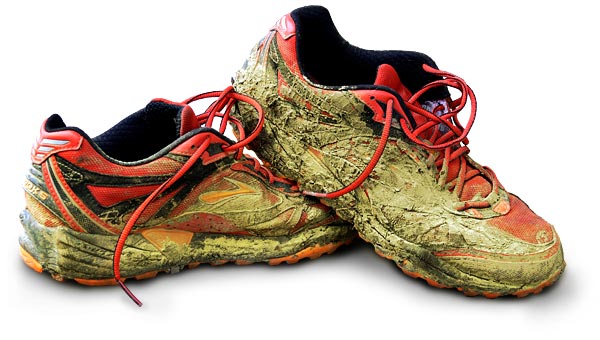
Gunky pine tree pollen on my Brooks Cascadia

Spring in South Carolina brings with it an airborne menace. You can taste it in your mouth, feel it in your eyes and see it all over your clothes. It’s pollen; a fine yellow dust thrown into the air by the superabundant pine trees.

The pine is a wind pollinated conifer. The yellow pollen is its male seed, set aloft in search of other alluring conifers to consummate the secret process you giggled about in 4th grade health class. When this pollen is released, the entire South is shrouded in a yellow miasma. You can literally see vast pollen clouds sweeping across the landscape as if from some bizarre late night horror flick: Killer Pollen 2. It’s our own annual chartreuse dustbowl. And this year, it’s been worse than ever.

According to the Allergic Disease and Asthma Center, the pollen count in South Carolina hit an astonishing 4,862 parts per cubic meter last week. Anything from 90 to 1,500 ppm³ is rated “extremely high.” It’s one of the worst allergy seasons on record. But it could be worse. Atlanta hit 5499 ppm³ last week: the pollen apocalypse.

In a cruelly ironic twist, pine pollen prevents Southerners from fully enjoying the mild spring weather. Spring lasts all of 3 weeks in South Carolina, so this is a big deal. Whereas the fresh air of early March would enliven any home, open windows simply invite interior pollination. And so windows remain closed. When the pollen finally relents, it’s too hot for fresh air, and time for the air conditioning to earn its keep.

Outside, pine pollen covers everything. The stuff is ubiquitous. A momentary excursion out of doors risks exposure. If you remain outside for any length of time, you’ll be visibly coated in the stuff. This of course poses a problem for runners, who routinely spend hours outside breathing heavily. The stuff gets in your throat, makes you exceedingly thirsty, and tastes just awful. Ever get really sick and hack up miserable yellow/green mucus? Yeah, you get the idea.

But you’ve not really experienced pine tree pollen until you’ve seen it through a headlamp on a pre-dawn trail run. You can almost count the thousands of individual pollen particles you’re ingesting. It’s much like a heavy fog if the fog were made up of dusty flaxen allergens instead of water vapor. Delicious.

Lack of rain is blamed for the horrid pollen this year. Rain pelts pollen from trees and mercifully scrubs it out of the air. This transforms the pervasive yellow dust into ghastly yellow paste: the gunky substance that attaches itself to my Brooks Cascadia trail shoes.

Despite all this, I haven’t altered my running schedule. I prefer the unpleasantness of the yellow scourge to the mind-numbing indoor alternative. I enjoy a heavy dose of yellow haze every day because I am allergic to tread mills not pine tree pollen.

I’m one of the lucky ones.
White Space