Archive for the 'Runner Physiology' Category

Maddening Tale of the Adductor Longus 06Oct08

Creepy Green Giant, circa 1954

In effort to keep physicians, physical therapists and makers of anti-inflamatory medication in the black, I proudly announce my latest running injury: the dreaded groin pull. It’s as uncomfortable as it sounds.

Worse, it’s completely disrupting my marathon schedule. I should be in the visceral, red meat section of my training regimen; the part where Burgess Meredith proclaims through grimy, clenched teeth that I eat lightning and crap thunder. Instead, I’ve been laid low by a deceptively nasty injury not easily described in mixed company.

Where to begin.

A groin pull is very much like a taffy pull, except you’re the taffy. Or, if you prefer vegetables; Imagine the Jolly Green Giant holds you aloft by your feet intent on slowly making a wishbone out of you. Distracted by his diminutive sidekick Sprout, he fails to finish the job. Sure, you may be alive but running is now out of the question.

One typically does not hear the word “groin” in polite conversation, unless of course you happen to know a runner. Then it’s mentioned frequently, without a hint of embarrassment.

Consider:
“Hey runner friend, what do you think of the new Asics Gel Nimbus 10?”

“The heel support is excellent fellow running aficionado, but there’s not enough cushioning to help with my groin.”

“That groin still bothering you? Provide exhaustive detail during our 10 mile training run.”

Things are different for non-runners, where references to the “groin” are uncommon. It’s a lonely word; too vulgar for high speech, and not offensive enough for low speech. The higher classes simply employ euphemisms like “nether regions” or “down there.” Lower classes proceed directly to the sterner, more colorful expletives. Neither are helpful.

Unless you’ve signed up for an Ancient Roman architecture class, you probably won’t read much about the groin, either. Even romance novelists avoid it. Why write wildly of burning groins, when burning loins will do nicely?

So we must turn to proper terminology. Medically speaking, I appear to have a strained, pulled or otherwise damaged adductor longus; one of the important muscles attaching the leg to the abdomen. Science then, has given us the ideal expression. A pulled adductor longus sounds vaguely alluring. Nobody wants a groin pull.

But if for some reason you’d like one, I suggest running incessant, high-mileage weeks with little or no breaks. When you feel the first twinge in your lower abdomen, by all means continue running, competitively if possible. In no time, you’ll be on the sidelines as your companions train in the gloriously autumnal weather.

For serious entertainment, return from the injury quickly, ignoring the sage advice of physicians, spouses, or runners with similar experience. Schedule a marathon immediately.

On that note, I hope to see you at the Lewis & Clark Siouxland Marathon on October 18th. Assuming I’m still in one piece, do flag me down at the Des Moines Marathon the next day.

- Dean

Playing the hand I was dealt. 25Jan07

Don’t hate me because I have the metabolism of Kate Moss.

I can’t help it if I don’t gain weight easily. As a kid, being skinny was not exactly a badge of honor. Actually, it was worse; I was also in the “gifted” program and liked Star Wars. The prototypical chick magnet, I was not. I blame my DNA. My genetic disposition leans toward the tall, gangly end of the spectrum. I was never meant to play fullback. I just don’t have the body type… or quite frankly the inclination.

Ever hear of Anthropometry? Those who have should apply for Jeopardy immediately. For the rest of us, it’s the “measurement of humans for the purposes of understanding physical variation.” From this study, intensely curious scientists have developed a breakdown of human body types called somatotypes. If this reminds you of the hallucinogenic drug that inspired orgies of sadism in Aldous Huxley’s Brave New World, please go to the head of the literature class.

Somatotypes come in three variations. The Endomorph’s body is round and soft. These folks gain weight easily and have difficulty keeping it off. Think football and John Goodman. The Mesomorph has an athletic frame and easily builds muscle. This is the idealized leading man; the jock; G.I. Joe. Then there is the Ectomorph. This body type is described as “lean,” “fragile,” “lightly muscled” and my personal favorite, “flat-chested.” This is me. I am a card-carrying ectomorph. However, I do not shop at the British store of the same name.

Presenting: The Ectomorph

Have I received the short end of the hereditary stick? It certainly seemed so in junior high. Ah, but the childhood curse is now a blessing. Most folks my age (including you mesomorphs) must fight a consistent, vigilant battle against weight gain. I do not share this problem. I’ve retained my boyish figure, and only throw up when I’m actually sick.

Ectomorphs possess distinct athletic advantages: We tend to dominate endurance sports. That’s right, I just used the word “ectomorph” and “dominate” in the same sentence. Seriously. Ectomorphs run marathons, play basketball, or go on to become fashion models (Would that my nose were straight).

So, rejoice fellow running ectomorphs! We’re doing what we were born to do! There’s something inherently satisfying about that. In Huxley’s world, there would have been no choice. But in reality, we had to choose to get off the couch in the first place.

White Space

Gastrocnemius Narcissism 24Oct06

My body has changed since I became a runner. In my first four months on the road, I shed over ten pounds (dramatic for a lanky guy like me). I’ve since gained the weight back, but my body feels leaner and now features the results of all the hard work: I’ve grown new muscle.

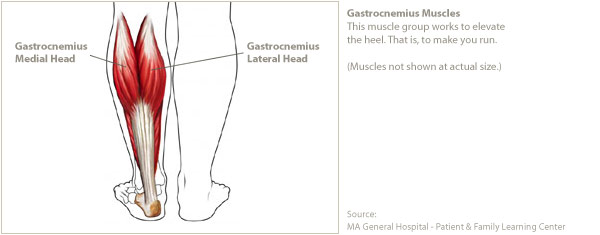
I’ve never really had muscle before. Well, not real muscle anyway. Where once peakish limbs supported my gangly frame, now rock solid calves with visible dual gastrocnemius definition propel my gangly frame forward.

The Muscles of the Calf - Gastrocnemius

Of course, body changes like this can have more than a physical effect. And I must confess, I grew unusually fascinated with my legs. I found myself staring at my calves. Flexing. Staring. Flexing some more. I just never had bona fide triceps surae before, and I was hooked. My sublime experience with calfdom went beyond novel to outright enthrallment. Ok, actually, it devolved into the shamefully hypnotic.

I once asked a friend if it was wrong that I ogle my calves in quasi-awe. He’s a man of faith, so I asked specifically if this oddball preoccupation was a sin.He replied, “Dean… yes. Yes, it is a sin. But if you must sin, please sin better.”